
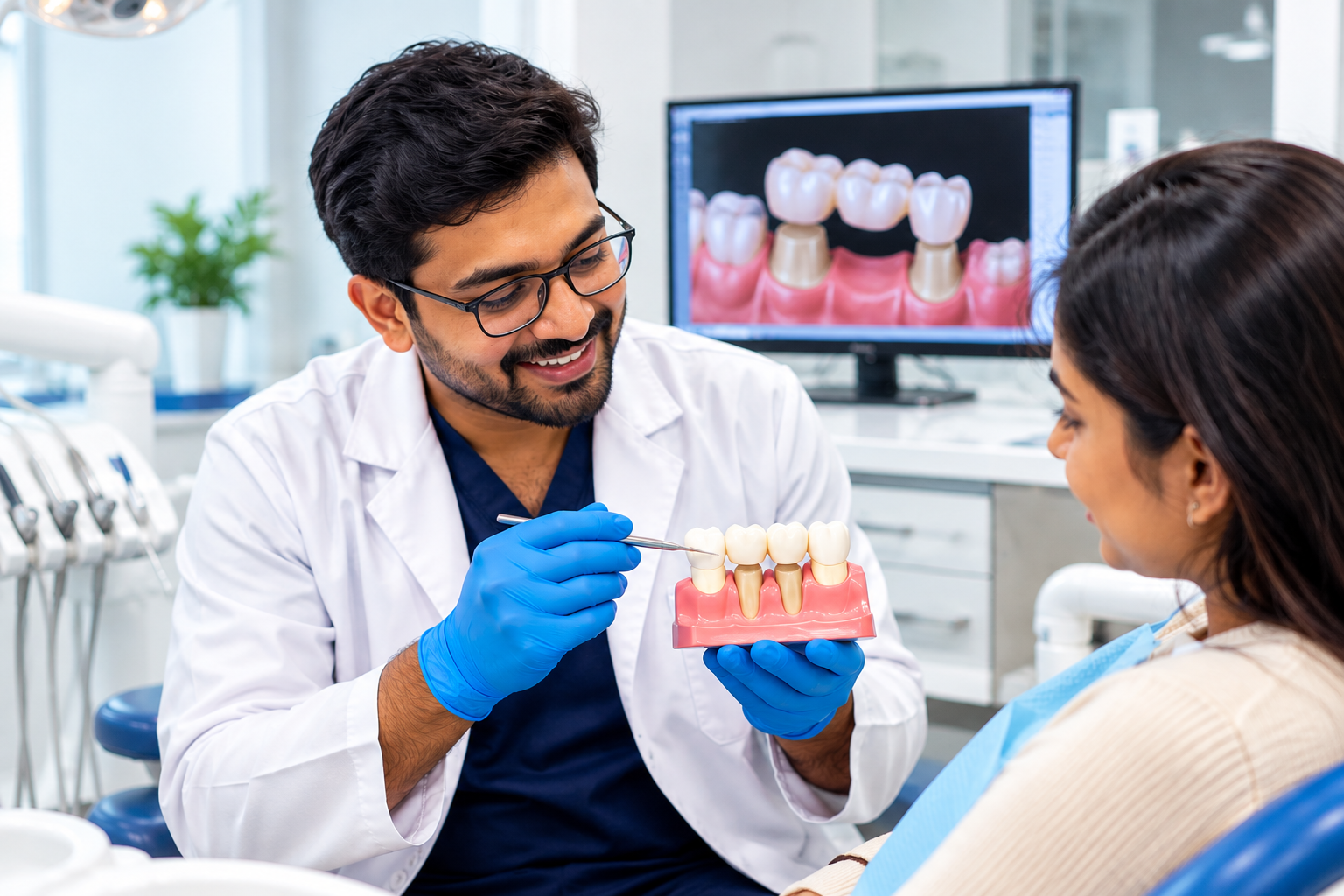
What Are Dental Crowns and Bridges?
Dental crowns and bridges are fixed dental restorations used to restore damaged teeth or replace certain missing teeth. A dental crown covers and protects an existing tooth, while a dental bridge replaces one or more missing teeth by using supporting teeth or implants.
At Dentistree Dental Clinic & Implant Center in Ulwe, crowns and bridges are planned after evaluating the teeth, gums, bite and supporting structures. The appropriate restoration depends on the condition of the teeth and individual treatment requirements.
When Do You Need a Dental Crown or Bridge?
Dental crowns and bridges may be recommended when a tooth requires additional protection or restoration, or when missing teeth need to be replaced. The appropriate treatment depends on the condition of the teeth, gums, bite and supporting structures.
Dental Crown May Be Considered For
- A significantly damaged or weakened tooth
- A tooth with a large restoration
- A root canal-treated tooth when additional protection is indicated
- A cracked or fractured tooth that can be restored
- Improving the shape or appearance of selected teeth
Dental Bridge May Be Considered For
- Replacement of one or more missing teeth
- Restoring chewing function in an edentulous space
- Improving appearance after tooth loss
- Selected cases where suitable supporting teeth are available
- Situations where a fixed tooth-replacement option is appropriate
A clinical examination and appropriate dental imaging help determine whether a crown, bridge, dental implant or another restorative option is suitable.
Types of Dental Crowns & Bridges
Dental crowns and bridges are available in different materials and designs. The choice depends on factors such as tooth position, bite forces, appearance, remaining tooth structure and individual clinical requirements.
Dental Crowns
- Metal-Ceramic (PFM) Crowns — combine a metal substructure with a tooth-coloured ceramic outer layer.
- All-Ceramic Crowns — tooth-coloured restorations used where aesthetics and function are important.
- Zirconia Crowns — ceramic restorations commonly considered for their strength and tooth-coloured appearance.
- Metal Crowns — may be considered in selected situations depending on clinical requirements.
Dental Bridges
- Conventional Dental Bridge — uses crowns on supporting teeth to replace the missing tooth or teeth.
- Cantilever Bridge — supported from one side in carefully selected cases.
- Resin-Bonded Bridge — uses bonded retainers and may be considered for selected missing teeth.
- Implant-Supported Bridge — supported by dental implants rather than natural teeth.
The most appropriate crown or bridge material and design is selected after evaluating the tooth or missing-tooth area, bite, supporting structures and treatment goals.
Dental Crown & Bridge Treatment Procedure
Treatment with a dental crown or bridge involves several stages to evaluate the teeth, prepare the required area and provide the final restoration. The exact procedure varies depending on the type of restoration and individual clinical condition.
01 — Examination & Treatment Planning
The teeth, gums, bite and supporting structures are evaluated clinically and with appropriate dental imaging to plan the restoration.
02 — Tooth Preparation
When required, the supporting tooth or teeth are carefully prepared to create adequate space and support for the planned crown or bridge.
03 — Impression or Digital Scan
An impression or digital scan is taken to record the prepared teeth and surrounding structures for fabrication of the restoration.
04 — Final Crown or Bridge Placement
The completed restoration is evaluated for fit, bite and appearance before being securely placed on the prepared tooth or supporting teeth.
Dental Bridge vs Dental Implant: What’s the Difference?
Dental bridges and dental implants are both fixed options for replacing missing teeth, but they differ in how they are supported. A conventional bridge generally uses neighbouring teeth for support, while a dental implant is placed in the jawbone to support a replacement tooth.
Dental Bridge
- Uses adjacent teeth for support in a conventional bridge
- Can replace one or more missing teeth in selected cases
- Supporting teeth may require preparation
- Does not involve placement of an implant in the jawbone
Dental Implant
- Uses an implant placed in the jawbone for support
- Does not rely on neighbouring teeth in the same way as a conventional bridge
- Requires assessment of bone and surrounding tissues
- Treatment planning and healing requirements differ from a conventional bridge
The appropriate option depends on the condition of the neighbouring teeth, available bone, gum health, bite and individual treatment requirements. Learn more about Dental Implants in Ulwe.
How Long Do Dental Crowns & Bridges Last?
The lifespan of a dental crown or bridge varies from person to person. It depends on factors such as oral hygiene, bite forces, condition of the supporting teeth and gums, restoration material and regular dental care.
Crowns and bridges can require repair or replacement over time if the restoration becomes damaged, the supporting tooth develops a problem, or the surrounding gum and bone condition changes.
Caring for Crowns & Bridges
- Brush regularly and maintain good oral hygiene
- Clean carefully around and underneath dental bridges
- Use floss or other interdental cleaning aids as advised
- Avoid habits that may damage the restoration
- Attend regular dental examinations
- Seek evaluation if the crown or bridge feels loose, painful or damaged
Regular dental care helps monitor both the restoration and the health of the supporting teeth and gums.
Dental Crown After Root Canal Treatment
After root canal treatment, the affected tooth requires an appropriate final restoration to restore function and protect the remaining tooth structure. Depending on the tooth, amount of remaining structure and biting forces, the final restoration may involve a filling or dental crown.
Dental crowns are commonly considered for root canal-treated back teeth when additional protection is clinically indicated. The need for a crown is determined individually after evaluating the treated tooth.
Why May a Crown Be Recommended After RCT?
- Helps protect the remaining tooth structure
- Restores normal chewing function
- Provides coverage for a weakened tooth when indicated
- Helps reduce the risk of fracture in appropriately selected cases
If you have an infected or painful tooth, learn more about our Root Canal Treatment in Ulwe.
Benefits of Dental Crowns & Bridges
Dental crowns and bridges can help restore damaged or missing teeth while supporting chewing function, tooth protection and smile appearance when appropriately planned.
- Helps restore damaged or weakened teeth
- Provides additional protection to selected teeth
- Restores chewing and biting function
- Can improve the appearance of damaged teeth
- Replaces missing teeth in suitable cases
- Helps restore continuity of the dental arch
- Provides a fixed tooth-replacement option
- Can improve smile appearance after tooth loss
The expected benefits depend on the condition of the teeth and gums, type of restoration, bite and individual treatment requirements.
Frequently Asked Questions About Dental Crowns & Bridges
A crown may be recommended after root canal treatment when the tooth requires additional protection, particularly when significant tooth structure has been lost or the tooth is exposed to substantial biting forces. The need for a crown is determined individually.
Tooth preparation is generally performed with local anaesthesia when required. Some temporary sensitivity or discomfort may occur after treatment, depending on the condition of the tooth and the procedure performed.
The lifespan varies depending on oral hygiene, bite forces, restoration material, condition of the supporting teeth and gums, and regular dental care. Crowns and bridges may require repair or replacement over time.
Both can be appropriate in selected cases. The choice depends on factors such as the condition of neighbouring teeth, available bone, gum health, bite and individual treatment requirements.
Tooth-coloured restorative materials can be selected to match surrounding teeth as closely as clinically possible. The final appearance depends on the material, tooth position, underlying structure and individual clinical situation.
Why Choose Dentistree for Dental Crowns & Bridges in Ulwe?
At Dentistree Dental Clinic & Implant Center in Ulwe, Navi Mumbai, dental crowns and bridges are planned after evaluating the condition of the teeth, gums, bite and supporting structures. Treatment focuses on restoring function, protecting remaining tooth structure and selecting an appropriate restoration for individual clinical needs.
Comprehensive Evaluation
Clinical examination and appropriate dental imaging help assess the teeth, supporting structures and missing-tooth area before treatment planning.
Individualized Treatment Planning
The type, material and design of the crown or bridge are selected according to the tooth condition, bite, appearance and individual treatment requirements.
Complete Restorative Care
Care includes treatment planning, tooth preparation when required, final restoration placement and appropriate follow-up.
Looking for other dental care options? Explore our Dental Treatments & Services in Ulwe, including dental implants, root canal treatment, braces, teeth cleaning and other restorative dental treatments.